
Understanding Habit Formation

Exploring the psychological and neurobiological foundations of how repeated nutritional behaviors become automatic patterns

Mindful eating moment with fresh food

Educational Content Only

Important: Educational content only. No promises of outcomes. This resource is designed to provide information about the science of habit formation in relation to nutritional choices and body weight understanding. It does not constitute medical advice, personal recommendations, or a program for weight management.

The Habit Loop Fundamentals

At the core of habit formation lies the habit loop—a three-part psychological cycle that explains how behaviors become automatic. This cycle consists of three essential components working in concert:

Cue (trigger), Routine (the behavior), and Reward (the benefit or satisfaction). When this cycle repeats consistently, the behavior gradually shifts from conscious decision-making to automatic response.

In the context of nutritional choices, the habit loop operates silently. Environmental signals—the sight of food, time of day, emotional state, social context—act as cues. The eating behavior becomes the routine. The satisfaction, taste, or emotional relief becomes the reward. Over time, these patterns integrate into daily behavior without deliberate thought.
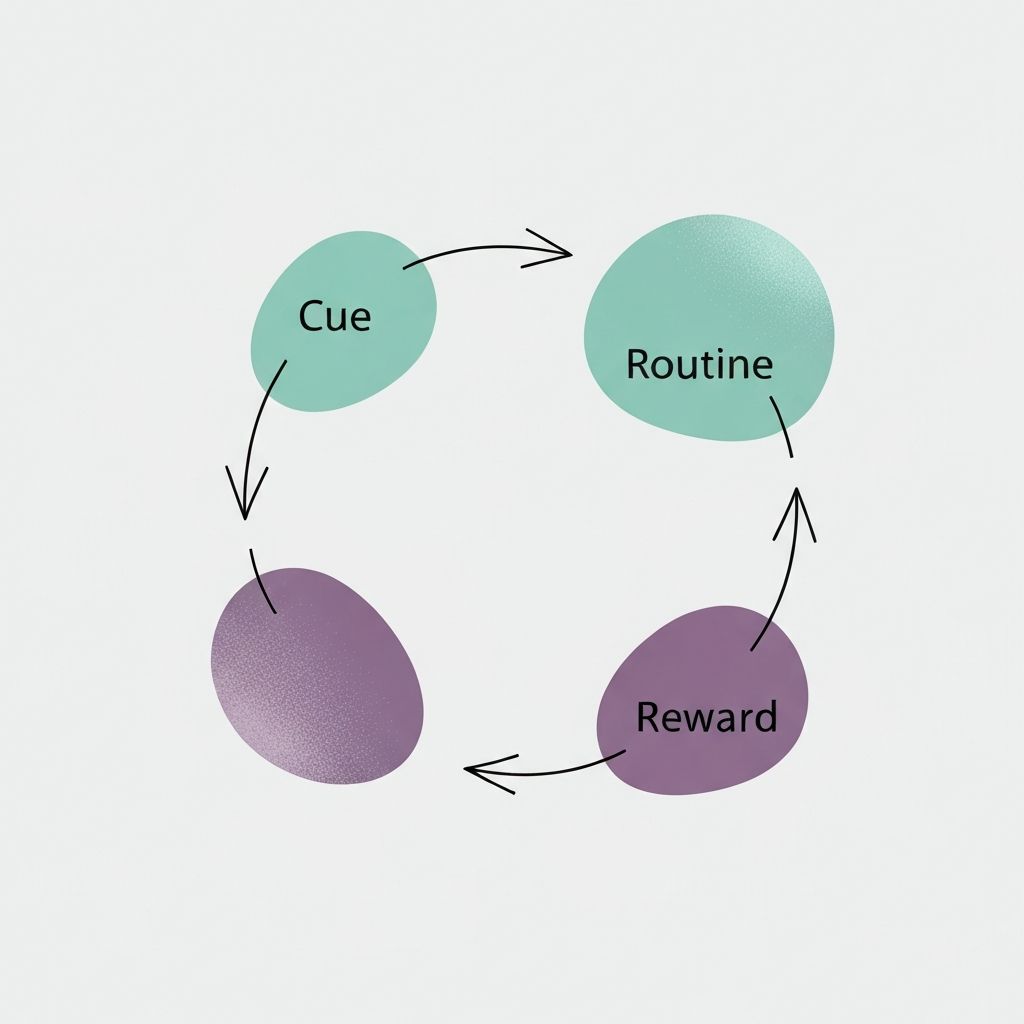

Minimalist illustration of cue-routine-reward cycle

Cues in Nutritional Context

Cues are the triggers that initiate habitual responses. In everyday eating, cues operate on multiple levels: sensory (the aroma of cooking), temporal (habitual meal times), emotional (stress or boredom), social (eating with others), and environmental (proximity to food sources).

Research in behavioral psychology demonstrates that repeated exposure to consistent cues strengthens the association between the cue and the automatic response. For example, regularly encountering food at a specific time or location creates a neural pathway that anticipates eating behavior when that context recurs.

These cues operate largely outside conscious awareness. Understanding the role of cues in nutritional patterns provides insight into why certain environments or times of day trigger predictable eating responses.

Fresh vegetables and fruits in natural light

Routine Formation Basics

The routine is the actual behavior—the action taken in response to a cue. In nutritional contexts, routines encompass not just what is eaten, but when, where, how much, and in what context food is consumed.

Neuroscientific research indicates that repeated routines gradually shift from requiring active attention to becoming automatic processes. This occurs through neural consolidation, where behavioral sequences become encoded in brain structures associated with habit execution rather than goal-directed action.

The formation of automatic routines has a practical consequence: repeated behaviors require less conscious effort over time. This automaticity can be neutral—neither beneficial nor detrimental—or it can reflect patterns that became ingrained through environmental conditions rather than deliberate choice.

Reward Mechanisms in Eating

Rewards are the experiences or sensations that reinforce habitual behaviors. In eating, rewards operate on multiple dimensions: the sensory pleasure of taste and texture, the neurobiological response to certain foods (involving dopamine and satisfaction pathways), emotional regulation, and social connection.

The brain's reward system evolved to reinforce behaviors essential for survival. Food consumption triggers reward responses as a motivational mechanism. However, in modern environments with abundant highly-palatable foods, these ancient reward pathways interact with contemporary food contexts in ways not reflected in evolutionary history.

Understanding reward mechanisms clarifies why certain eating patterns persist: the brain encodes and anticipates rewarding outcomes, making those behaviors attractive and difficult to interrupt through willpower alone.

Fresh berries and fruits in soft lighting

Environmental Habit Influences

The physical and social environment shapes habitual eating patterns profoundly. Factors including food availability, proximity, visibility, packaging size, eating location, and social norms all influence how often and how much eating occurs, often independently of hunger or conscious decision.

Environmental design studies demonstrate that structural factors—such as the placement of foods in kitchens or the default portion sizes offered in social settings—predict eating behavior more reliably than individual motivation or knowledge about nutrition.

Habits persist because they are embedded in stable environments. When environmental contexts change, the automatic triggers may cease to activate, potentially interrupting long-established patterns. This observation highlights the interconnection between habit, environment, and behavior.

Calm kitchen scene with eating environment

Habit vs. Conscious Choice

A critical distinction exists between conscious eating decisions and automatic eating responses. Conscious choice involves deliberation, evaluation of options, and intention. Automatic responses bypass this deliberation—they occur through habit activation.

Neuroimaging studies reveal that conscious decisions and habitual actions involve different neural pathways and brain structures. Habitual behaviors engage the basal ganglia, while goal-directed actions activate prefrontal cortex regions associated with decision-making and evaluation.

The coexistence of both processes means that individuals may simultaneously hold nutritional knowledge and intentions while engaging in automatic eating patterns shaped by habit, cues, and environmental structure. Understanding this duality provides context for the complexity of dietary behavior.

Featured Articles

Repeated eating moments suggesting habit

The Basic Structure of Habit Loops

Explore the psychological foundations of how the cue-routine-reward cycle creates and maintains automatic behaviors in daily eating patterns.

Continue reading →
Repeated eating moments suggesting habit

How Food Cues Trigger Automatic Responses

Discover how environmental signals and contextual factors activate ingrained eating behaviors without conscious awareness or deliberate choice.

Continue reading →
Repeated eating moments suggesting habit

Repetition and Neural Pathway Strengthening

Learn about the neurobiological process through which repeated behaviors become encoded in brain structures supporting automaticity.

Continue reading →

Frequently Asked Questions

What is a habit loop?

A habit loop is a three-part cycle of behavior: a cue (trigger), a routine (the behavior), and a reward (the satisfaction or benefit). When repeated consistently, this cycle becomes automatic and moves from conscious decision-making to unconscious response.

How do habits form at the neurobiological level?

Through repeated activation, behavioral sequences become encoded in brain structures associated with automatic processing, particularly the basal ganglia. This neural consolidation process gradually reduces the cognitive resources needed to perform the behavior.

What are examples of eating cues?

Eating cues can be sensory (aroma or sight of food), temporal (specific times of day), emotional (stress or boredom), social (eating with others), or environmental (proximity or accessibility of food). Cues operate largely outside conscious awareness.

Can environment influence automatic eating patterns?

Yes. Environmental factors such as food placement, visibility, portion size defaults, and social norms significantly influence eating frequency and quantity, often independent of conscious intention or nutritional knowledge.

What is the difference between habit and conscious choice in eating?

Conscious eating involves deliberation and intention. Automatic eating responses occur through habit activation—triggered by cues without deliberative processing. Different neural pathways support each process.

How do reward mechanisms reinforce eating habits?

Reward mechanisms—sensory pleasure, neurobiological responses (dopamine), emotional regulation, or social satisfaction—reinforce behaviors by making them attractive to the brain. Repeated pairing of cues with rewards strengthens automatic associations.

Is this information a substitute for professional guidance?

No. This resource provides general educational information about the science of habit formation. It does not constitute personalized advice, medical guidance, or a program for any specific outcome. Individuals should consult qualified professionals for personalized recommendations.

What does "educational content only" mean?

It means this resource explains scientific concepts about habit formation and nutritional behavior patterns. It does not promise specific outcomes, provide medical treatment, or serve as a replacement for professional consultation.

Explore the Science Further

Deepen your understanding of habit formation, behavioral psychology, and nutritional patterns through our comprehensive blog articles and research-based insights.

Discover Related Research